Concrete pipe manufacturing process includes mix preparation, reinforcement where required, mould filling, mechanical compaction, demoulding, curing and quality control. Pipe diameter, wall thickness and load capacity vary according to drainage, sewer, stormwater and other infrastructure applications.
Concrete pipe manufacturing process may use dry-cast or wet-cast concrete. Very low-slump dry mixes can be mechanically compacted and demoulded relatively quickly, while wet-cast concrete usually remains supported by the mould for a longer period.
What Materials Are Used for Concrete Pipes?
Typical ingredients include:
The concrete mixture must suit the pipe diameter and the selected manufacturing method. In reinforced products, the position of the steel cage and concrete cover are also part of production quality.
These points should not be read as an isolated checklist. Each one affects a different part of design or production, and changes in one parameter can influence the behaviour of the others.
- Cement
- Fine aggregate
- Coarse aggregate
- Water
- Chemical admixtures
- Mineral additions where required
Taken together, these points explain why one numerical value is rarely enough to define a reliable solution. The final decision should combine project requirements, material behaviour and actual production conditions.
Reinforced pipes also include a steel cage designed according to the structural requirements of the unit.
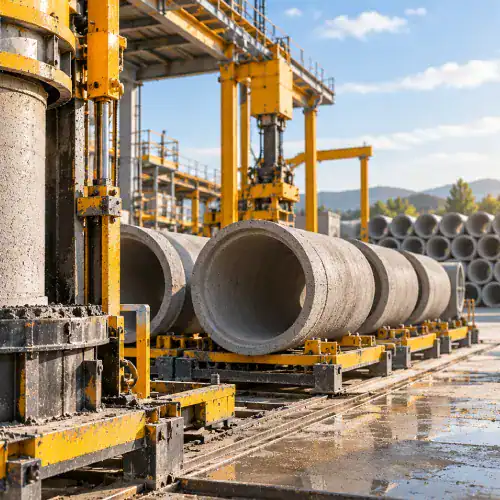
How Is a Concrete Pipe Mould Filled?
Concrete is fed into the space between the inner and outer forms. Uniform distribution around the circumference helps maintain consistent wall thickness.
The objective during feeding is to distribute the concrete evenly around the circumference. Local overfilling or underfilling can translate into wall-thickness variation after compaction.
Concrete pipe making machines are designed around mould handling, concrete feeding and compaction for different pipe dimensions.
It is useful to separate the main variables for clarity, although they remain closely connected in practice. The following points show which technical factors shape the final decision.
A typical sequence includes:
- Preparing the mould
- Positioning reinforcement
- Setting inner and outer forms
- Feeding concrete
- Compacting the mixture
- Forming the pipe ends
- Demoulding
- Moving the product to curing
The key is not to optimise any one item in isolation. Stable production depends on keeping these variables compatible with one another throughout the process.
Why Is Vibration Used?
Very low-slump concrete requires mechanical compaction.
In dry-cast pipe production, vibration helps form a dense and continuous wall section. Machine settings need to reflect pipe dimensions and mix behaviour to maintain internal and external surface quality.
Several variables are assessed at the same time in real production. The items below explain the main data that should be considered before a mix, machine setting or production step is confirmed.
Poor compaction can cause:
- Surface voids
- Low density
- Uneven wall thickness
- Weak edges
Knowing the individual values is only part of the task; their interaction also needs to be controlled. This is especially important when repeatability between batches or products is a quality target.
The vibration setting should match the concrete mixture and pipe dimensions.
How Are Concrete Pipes Demoulded?
Dry-cast production can allow relatively rapid demoulding once the concrete has been adequately compacted.
Early demoulding can improve production cycle time, but the fresh pipe must have enough stability to support its own weight and retain joint geometry during handling.
A crane-system concrete pipe machine can integrate mould handling with production of different pipe diameters.
Breaking the process into individual factors makes the technical logic easier to follow. In practice, however, these factors work together and should be reviewed as part of one production system.
During demoulding:
- Pipe geometry must remain stable.
- Joint areas must be protected.
- Fresh units must be lifted correctly.
- Deformation during handling must be prevented.
All of these factors influence whether a theoretical design performs as expected in real production. Regular measurement and record keeping make it easier to identify the source of variation.
How Are Concrete Pipes Cured?
Fresh concrete pipes require controlled moisture conditions for continued hydration.
Controlled curing helps the concrete develop strength more uniformly through the wall section. Where accelerated methods are used, temperature rise and holding periods should be managed carefully.
The outcome depends on balancing a small number of critical parameters rather than optimising a single value. The following points show where that balance is established.
Good curing supports:
- Strength development
- Reduced moisture loss
- Lower risk of early cracking
- More consistent product quality
The list highlights the critical control points, but product quality comes from managing them consistently over time. Small deviations can become significant in high-volume production.
How Is Concrete Pipe Quality Controlled?
Checks may include:
Because pipes form continuous underground systems, dimensional deviations can create problems at joints even when the concrete itself is strong. Dimensional checks therefore complement structural and watertightness testing.
The difference between a theoretical specification and reliable production often appears in these details. Each of the following factors therefore needs to be assessed under actual operating conditions.
- Internal diameter
- External diameter
- Wall thickness
- Length
- Joint geometry
- Surface quality
- Concrete strength
- Watertightness
- Load performance
- Reinforcement location
These parameters should therefore be treated as one connected system. Reliable results come from matching material properties with the machine, process and site conditions.
Machine configuration can be discussed through the CONMACH contact page once pipe dimensions and production targets are defined.
Frequently Asked Questions
What concrete is used for concrete pipes?
Very low-slump dry-cast mixes are common, while wet-cast methods are also used.
Why is vibration used?
It helps compact the concrete and reduce internal voids.
Are all concrete pipes reinforced?
No. Reinforcement depends on the design and required performance.
Can pipes be demoulded immediately?
Dry-cast pipes can often be demoulded relatively quickly after compaction.
How are concrete pipes cured?
They are kept under conditions that support continued cement hydration.
How is a concrete pipe machine selected?
Pipe diameter, length, required output and mould-handling system are key criteria.