The main difference between a jaw crusher and a cone crusher lies in their crushing geometry and the roles they typically perform within a crushing and screening circuit. Both machines primarily use compression to reduce material, but a jaw crusher compresses rock between a fixed and a moving jaw, while a cone crusher crushes material between a moving mantle and a fixed concave surface.
This difference affects acceptable feed size, product gradation and where each machine is normally positioned in the process.
Jaw crushers are widely used to reduce large feed at the beginning of a crushing line. Cone crushers are more commonly used after the feed has already been reduced and a smaller, more controlled product is required.
The question is therefore not simply whether a jaw crusher or cone crusher is “better.” The correct machine depends on feed size, hardness and abrasiveness, required final product, capacity and the complete process configuration.
Contents
How Do Jaw Crushers and Cone Crushers Work?
Although both machines break material through compression, material behaves differently inside their crushing chambers.
Jaw crushers use two primary crushing surfaces: one fixed jaw and one moving jaw. Large material enters through the upper opening and is compressed as the moving jaw approaches the fixed plate. As the opening increases again, smaller fragments move downward until they are able to leave through the discharge opening.
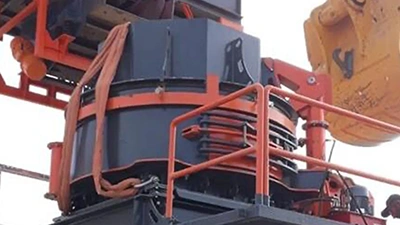
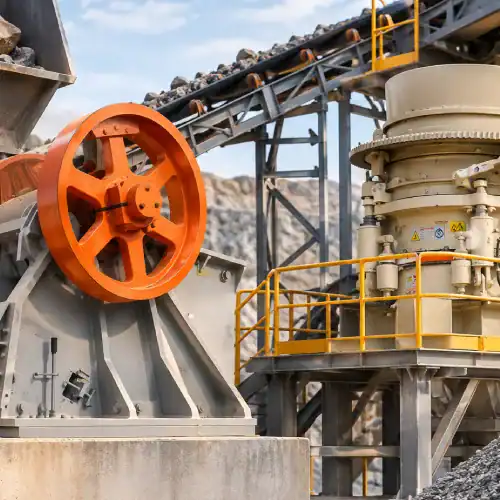
Cone crushers use an eccentrically moving mantle inside a fixed concave. The changing gap around the crushing chamber creates repeated compression as material moves downward.
How Does a Jaw Crusher Reduce Material?
A jaw crusher works through a repeated compression cycle.
Its main crushing elements are:
- the fixed jaw,
- the moving jaw,
- the crushing chamber formed between them.
When the moving jaw approaches the fixed jaw, material is compressed and fractured. When it moves away, the broken pieces move downward.
This relatively large feed opening is one of the reasons jaw crushers are commonly selected for primary size reduction of blasted or quarried rock.
How Does a Cone Crusher Reduce Material?
A cone crusher produces compression between the mantle and concave.
Because the mantle moves eccentrically rather than simply opening and closing as a jaw does, crushing takes place continuously at different points around the chamber.
As material travels downward, the available space becomes smaller and the particles are reduced progressively.
This operating principle makes cone crushers well suited to downstream applications where feed has already been reduced and greater control over output size is required.
What Are the Main Differences Between a Jaw Crusher and a Cone Crusher?
The two machines differ in more than mechanical design. Feed size, process stage and product requirements should all be considered.
A general comparison is:
| Criterion | Jaw Crusher | Cone Crusher |
|---|---|---|
| Typical stage | Primary crushing | Secondary and tertiary crushing |
| Feed | Can accept relatively large feed | Usually requires pre-crushed feed |
| Principle | Compression between fixed and moving jaws | Continuous compression between mantle and concave |
| Typical output | Coarser first-stage product | Smaller, more controlled product |
| Hard rock | Suitable | Suitable, particularly downstream |
| Main purpose | Initial size reduction | Further reduction and product control |
These are general process characteristics rather than fixed rules. Actual feed openings, settings and capacities depend on the selected crusher model and operating conditions.
How Does Feed Size Affect the Choice?
Large feed size is one of the strongest reasons to use a jaw crusher at the beginning of a process.
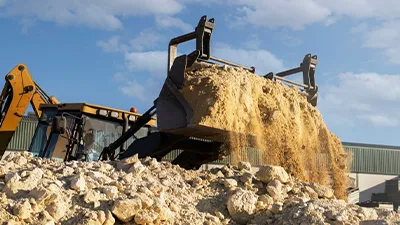
Rock coming directly from a quarry face or excavation can often be fed into a suitable primary jaw crusher after controlled feeding and, where required, scalping.
Cone crushers normally accept a smaller top feed size. They are therefore frequently positioned after a primary crusher.
Feeding material that is too large for the selected cone chamber can restrict flow, reduce effective performance and create operating problems.
How Does the Final Product Differ?
The primary purpose of a jaw crusher is often to make large feed manageable for the next stage.
Material leaving the jaw may therefore not yet be the final saleable aggregate.
Cone crushers are used where finer reduction and better control of the product gradation are needed. With the correct chamber, settings and feed conditions, they can also contribute to improved particle shape.
Product requirements should therefore be defined before choosing a machine.
Which Crusher Is Better for Hard and Abrasive Rock?
Both technologies can process hard material.
Jaw crushers are particularly useful when large pieces of hard or abrasive rock first enter the plant. Cone crushers are widely used for further reduction of hard and abrasive materials after the primary stage.
For this reason, jaw and cone crushers are often complementary rather than competing technologies within crushing and screening plants.
How Does Abrasiveness Affect Crusher Selection?
Abrasive rock causes wear on components that are directly exposed to the material.
For jaw crushers, jaw plates are key wear components. In cone crushers, the mantle and concave are among the principal wear surfaces.
Selection should therefore consider:
- material abrasiveness,
- required reduction ratio,
- expected wear life,
- access for maintenance,
- annual production target.
Operating a crusher with heavily worn liners or plates can also alter capacity and product gradation.
Wear management should therefore be considered as part of the production process rather than only as a spare-parts issue.
Why Is Controlled Feeding Important for Cone Crushers?
Cone crushers generally benefit from consistent and well-distributed feed.
Large variations in feed rate or material entering predominantly from one side can produce uneven chamber loading and wear.
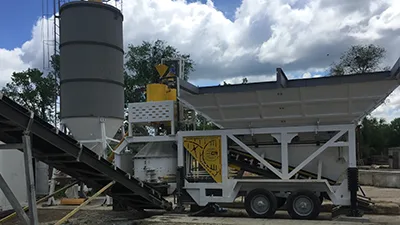
Feeders, hoppers and conveyors therefore influence cone crusher performance even though they are separate machines.
Jaw crushers also require controlled feeding, particularly to avoid overload and maintain stable production, but the optimum feed conditions differ because of the different chamber geometry.
Should You Choose a Jaw Crusher or a Cone Crusher?
In many multi-stage plants, the correct answer is not one or the other. Both may be required.
Large quarry feed can first be reduced by a jaw crusher. Screens then classify the material, and fractions requiring additional reduction can be sent to a cone crusher.
The decision should therefore start with the required final products and work backwards through the process.
What Information Is Needed Before Selecting a Crusher?
Specifying only a target such as “100 tonnes per hour” is not enough for reliable crusher selection.
Useful project data includes:
- material type,
- hardness and abrasiveness,
- maximum feed size,
- feed-size distribution,
- required product fractions,
- target throughput,
- open- or closed-circuit operation,
- capacities of screens and conveyors.
With this information, it becomes easier to determine whether a jaw crusher, cone crusher or combination of both should be used.
Why Is Rated Tonnes per Hour Not Enough?
A crusher may have a high nominal capacity while the complete plant produces less.
If a primary jaw crusher sends more material than the downstream cone crusher, screen or conveyors can handle, the next stage becomes the bottleneck.
Closed-circuit operation can also increase recirculating load when a large proportion of material needs to be crushed again.
Actual plant capacity is therefore determined by the balance of the entire process rather than the largest number shown in one machine specification.
Frequently Asked Questions About Jaw and Cone Crushers
Which is more powerful, a jaw crusher or a cone crusher?
“Power” is not a useful standalone comparison. Jaw crushers are effective for large primary feed, while cone crushers are designed mainly for further reduction in downstream stages.
Can a cone crusher be used as a primary crusher?
It can be possible in certain feed conditions, but cone crushers are normally used in secondary and tertiary stages.
Are jaw crushers used only for primary crushing?
No. Some jaw crusher designs can perform other duties, although primary crushing is their most common application.
Which crusher is better for hard rock?
Both can be suitable. A common arrangement uses a jaw crusher for large hard feed and a cone crusher for subsequent reduction.
Can jaw and cone crushers be used in the same plant?
Yes. Combining them in different crushing stages is common in multi-stage aggregate and mineral-processing circuits.
Design the Crushing Circuit Around the Material
The most useful comparison is not simply jaw crusher versus cone crusher. The objective is to determine which machine should perform each reduction stage between incoming rock and the required final product.
Review CONMACH's jaw and cone crusher solutions, then share your feed size, material characteristics, required product fractions and capacity through the CONMACH contact page to evaluate a suitable crushing circuit.
Contact Us