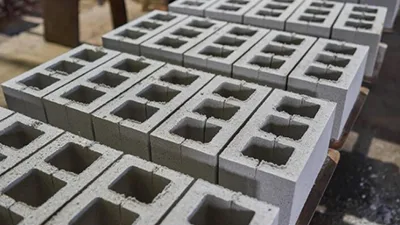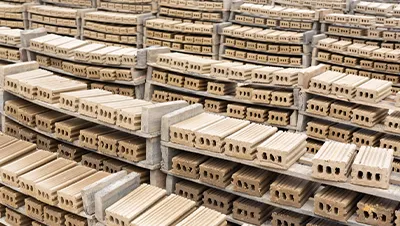
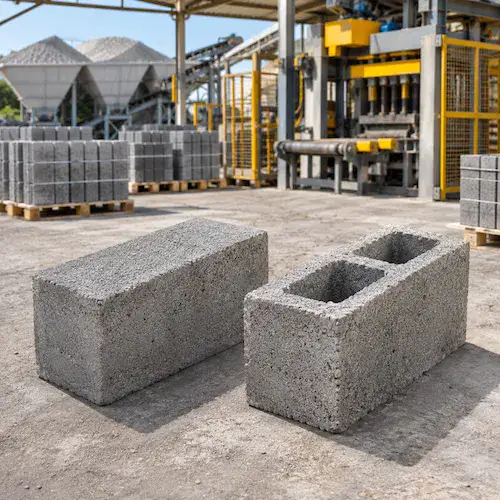
The main difference between solid and hollow concrete blocks is the amount of concrete within the cross-section of the unit. Solid units contain a greater volume of concrete, while hollow blocks include one or more internal cores.
This difference affects unit weight, material consumption, wall mass and several thermal, acoustic and construction characteristics.
It is important, however, not to assume that a solid block is automatically stronger or that a hollow unit is always non-loadbearing. Both solid and hollow concrete masonry units can be used in loadbearing or non-loadbearing applications when their properties and the wall design meet the relevant project requirements.
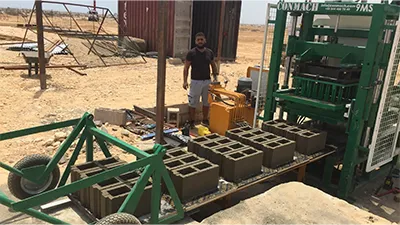
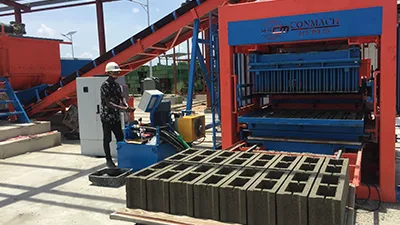
CONMACH concrete block machines are available in semi-automatic and automatic configurations for different block sizes and production capacities. Choosing which block to manufacture should therefore begin with the required product specification rather than machine output alone.
Contents
- What Is the Structural Difference Between Solid and Hollow Concrete Blocks?
- How Do Thermal, Acoustic and Fire Properties Differ?
- Where Are Solid and Hollow Concrete Blocks Used?
- How Does Production Differ Between Solid and Hollow Blocks?
- Frequently Asked Questions About Solid and Hollow Concrete Blocks
What Is the Structural Difference Between Solid and Hollow Concrete Blocks?
The most visible distinction is the amount of concrete in the unit. If two blocks have the same external dimensions and are made from concrete of the same density, the solid unit will generally contain more material and therefore weigh more.
A hollow unit uses internal cores to reduce concrete volume and unit mass.
Are Hollow Concrete Blocks Always Lighter?
Under comparable conditions, usually yes.
However, unit weight also depends on:
- concrete density,
- aggregate type,
- overall block dimensions,
- face-shell and web thickness,
- core geometry,
- whether cells are later filled with grout.
A block made with lightweight aggregate may weigh less than expected even if it contains a relatively high volume of concrete.
For this reason, actual unit weight and density are more useful comparison values than the words “solid” or “hollow” alone.
Are Solid Blocks Always Stronger?
No.
The structural performance of a concrete masonry unit depends on:
- concrete compressive strength,
- unit geometry,
- manufacturing and compaction quality,
- curing,
- mortar and wall construction,
- reinforcement and grout where required.
Both hollow and solid units may be designed for structural or nonstructural use.
The correct comparison is therefore between specified unit properties and wall design requirements, not simply between two shapes.
How Do Thermal, Acoustic and Fire Properties Differ?
A common mistake is to associate one performance characteristic directly with the unit type. Statements such as “hollow blocks always insulate better” or “solid blocks always stop more sound” are too general.
Thermal and acoustic behaviour depend on density, wall thickness, aggregate type, cell configuration and whether the cores are empty, insulated or grouted.
Do Hollow Cores Improve Thermal Performance?
Internal cores reduce the amount of concrete within the unit and therefore influence heat transfer.
Lower-density units can also exhibit lower thermal conductivity. Core geometry and insulation placed inside cells can further change wall performance.
This means a hollow block can provide useful thermal characteristics in some wall systems, but the presence of voids alone does not guarantee a particular insulation value.
Why Does Mass Matter for Sound Control?
Wall mass is one of the variables influencing sound transmission.
All other factors being comparable, greater mass and density can improve some airborne sound ratings.
Actual acoustic performance also depends on:
- unit thickness,
- density,
- grout or insulation within cores,
- mortar joints,
- surface finishes.
A hollow wall that is fully or partially grouted can therefore behave very differently from the same unit used with empty cells.
Is Fire Resistance Determined by Whether a Block Is Solid?
No.
Concrete masonry fire resistance is influenced by factors such as aggregate type, equivalent thickness and the amount of concrete within the wall assembly.
Fire ratings should therefore be based on tested or recognised wall-system data rather than appearance alone.
Where Are Solid and Hollow Concrete Blocks Used?
Block selection should reflect the function of the wall, required structural behaviour, handling requirements and construction details.
Hollow blocks can reduce unit weight and provide cells for reinforcement or grout. Solid units can provide greater mass and a continuous concrete section where that characteristic is useful.
Neither product should be selected using a universal “better or worse” rule.
Where Are Hollow Concrete Blocks Used?
Hollow concrete units can be used for:
- internal and external walls,
- partitions,
- designed loadbearing masonry,
- reinforced or grouted walls,
- projects where lower unit weight improves handling.
The cores can also provide space for vertical reinforcement and grout when required by the structural system.
This makes hollow units particularly versatile in engineered masonry construction.
Where Are Solid Concrete Blocks Used?
Solid or high-solid-content units may be used where:
- greater unit mass is desirable,
- a more continuous concrete section is required,
- local construction details specify solid units,
- particular impact or application requirements apply.
The final decision should still be based on project specifications and verified product properties.
A solid block should not automatically be substituted for an engineered hollow unit on the assumption that more concrete always means greater wall capacity.
How Does Production Differ Between Solid and Hollow Blocks?
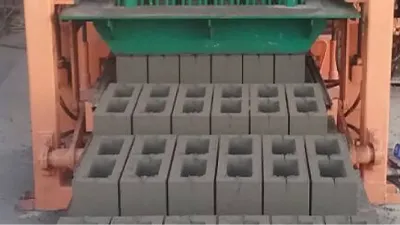
Both types can be manufactured using dry or semi-dry concrete that is fed into a mould, consolidated through vibration and pressure, demoulded and then cured under suitable conditions.
One of the main differences is the mould geometry.
CONMACH concrete block machines can be configured for different block dimensions, while product form is determined by the mould and production setup.
Do Hollow Blocks Use Less Concrete?
For equal external dimensions and similar material density, yes.
Internal cores reduce the net concrete volume in each unit.
This can influence:
- raw-material consumption,
- unit weight,
- pallet loads,
- transport and storage planning.
The economic decision should not be based on material saving alone.
Mould cost, cycle time, expected selling price, production volume and local demand also matter.
Does Machine Capacity Change With Block Size?
Yes.
Concrete block machine output depends on product dimensions, the number of units produced per mould cycle and machine cycle time.
CONMACH publishes different shift capacities for 10×20×40 cm, 15×20×40 cm and 20×20×40 cm units on the same machine models. This illustrates why production capacity cannot be discussed without defining the actual product.
Which Product Should a New Production Line Target?
The decision should follow market demand.
A manufacturer should evaluate:
- locally preferred block sizes,
- loadbearing and non-loadbearing markets,
- raw-material cost,
- transport distance,
- target unit price,
- whether paving stones or other products will also be produced.
Defining the product first makes it easier to select the correct machine, mould system and automation level.
Frequently Asked Questions About Solid and Hollow Concrete Blocks
Are solid concrete blocks always stronger?
No. Strength depends on unit material, geometry, manufacturing quality and wall design.
Can hollow blocks be loadbearing?
Yes, when the unit and wall system meet the applicable structural requirements.
Do hollow blocks always provide better insulation?
Not automatically. Density, aggregates, geometry and the complete wall assembly influence thermal performance.
Are solid blocks heavier?
With the same external dimensions and concrete density, they generally contain more concrete and are therefore heavier.
Can one block machine produce both solid and hollow products?
Different block geometries can be produced where the machine and appropriate mould system are designed to support them.
Define the Product Before Selecting the Production Line
Choosing between solid and hollow blocks affects material consumption, handling, transport, mould design and the market position of the finished product.
Review CONMACH concrete block machines for different block sizes and production capacities, or contact CONMACH to evaluate a machine and mould configuration around the products you intend to manufacture.
Contact Us