Vibrating screen capacity is not determined by screen width or motor power alone. Feed rate, particle-size distribution, bulk density, moisture, aperture size, number of decks and material bed depth all influence actual performance.
A screen is one of the key process components in a crushing plant because it determines which particles become finished products and which return for further reduction.
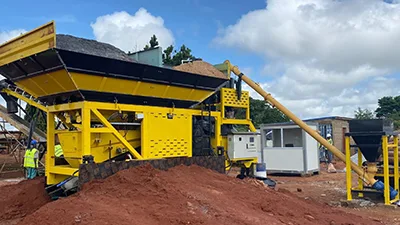
CONMACH offers vibrating screens in different dimensions and deck configurations for material classification.
Contents
What Determines Vibrating Screen Capacity?
Capacity is normally discussed as tonnes per hour, but the same machine can process two different materials at very different rates.
Dry crushed stone that flows easily does not behave like damp material containing clay or a high proportion of fines.
Why Does Screening Area Matter?
Screen width influences how much material can be spread across the deck.
Screen length provides additional time and contact area for smaller particles to reach openings.
A larger screen, however, cannot compensate for poor feed distribution. If material enters only one side, a large portion of the available surface remains underused.
How Does Aperture Size Affect Capacity?
Larger openings generally allow easier passage of undersize particles.
Fine separation is more demanding because particles close to the target cut size require sufficient contact opportunities with the screen surface.
These near-size particles are often among the most difficult to classify.
Capacity should therefore always be evaluated together with the required cut size.
Why Do Moisture and Clay Matter?
Moist or sticky fines can adhere to screen media and close the openings.
As open area decreases, capacity and separation efficiency fall even though the physical dimensions of the screen have not changed.
Feed moisture should therefore be included in equipment-selection data.
How Is Screening Efficiency Evaluated?
High throughput does not automatically mean high screening efficiency.
Efficiency describes how successfully particles report to the correct product stream.
If a significant quantity of undersize remains in the oversize stream, separation quality is poor even if the machine processes many tonnes per hour.
What Happens When the Material Bed Is Too Deep?
Excessive feed creates a thick bed.
Fine particles located near the top of the bed may not reach the screening surface before the material leaves the deck.
The correct response is not automatically to increase vibration. Feed rate, screen area and distribution should first be checked.
What Do Frequency and Amplitude Control?
Vibration helps move material, loosen the bed and create opportunities for particles to contact the apertures.
Frequency, amplitude and motion pattern are selected according to screen design and material behaviour.
Incorrect operating conditions can cause material to move too quickly, reduce stratification or place unnecessary mechanical loads on the equipment.
How Do Multiple Decks Affect Screening?
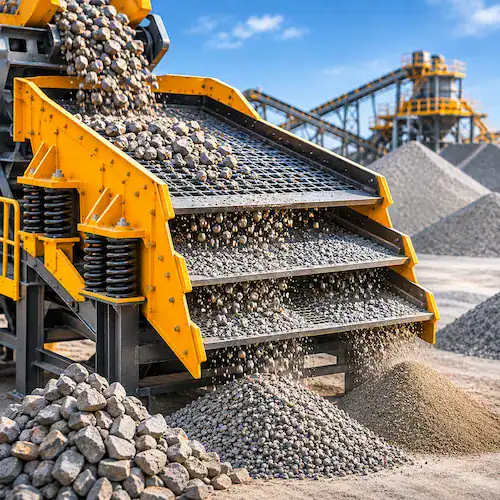
Multi-deck screens allow several products to be separated in one machine.
Each deck performs a different cut, and the load on lower decks depends on what passes through the decks above.
Do More Decks Automatically Increase Capacity?
No.
Additional decks increase the number of possible product fractions, not necessarily the overall throughput.
Each deck still requires sufficient area for its separation duty.
The number of products, feed rate and cut sizes must therefore be considered together.
How Does a Screen Affect Crusher Capacity?
In a closed circuit, oversize material identified by the screen returns to the crusher.
Poor separation can increase recirculating load and consume crusher capacity that could otherwise process new feed.
A balanced crushing and screening plant therefore requires crushers and screens to be sized as one process.
How Can Screening Performance Be Improved?
Improvement often starts with correcting operating conditions rather than simply installing a larger motor.
Feed distribution, worn media, blocked openings and material bed depth should be inspected routinely.
What Happens When Screen Media Wears?
Damaged or enlarged apertures can allow off-size material into the wrong product.
Loose media can also affect vibration transmission.
Routine inspection should include:
- screen panels or wire cloth,
- mounting points,
- springs,
- bearings,
- drive units,
- feed chutes.
Why Is Feed Distribution Important?
Material delivered to only one side of the screen reduces usable area.
Feed chutes and distribution systems should spread material across the available width as evenly as practical.
Correcting distribution can improve utilisation without increasing the nominal screen size.
Frequently Asked Questions
How is vibrating screen capacity determined?
Screen area, aperture size, feed rate, density, gradation, moisture and deck arrangement all need to be considered.
Does a larger screen always provide greater capacity?
It provides more potential screening area, but actual capacity still depends on material and operating conditions.
What is a multi-deck screen?
It uses multiple screening surfaces to produce several particle-size fractions.
Why do screen apertures become blocked?
Moisture, sticky fines and unsuitable media can cause blinding or plugging.
Can poor screening reduce crusher throughput?
Yes. In closed circuits, poor classification can increase recirculating load.
Size the Screen Around the Required Separation
Screen selection should begin with the feed gradation and required product sizes, not only a target tonnes-per-hour figure.
Share your feed characteristics, required cuts and production target through the CONMACH contact page to evaluate a suitable screen configuration.
Contact Us