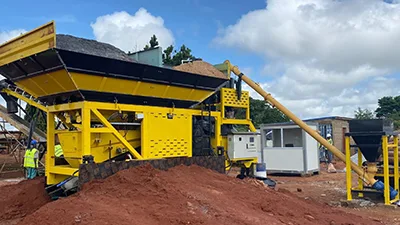
The difference between mobile and stationary concrete batching plants goes beyond portability. Site preparation, storage infrastructure, achievable production flow, maintenance planning and the expected life of the project all influence which configuration is more appropriate.
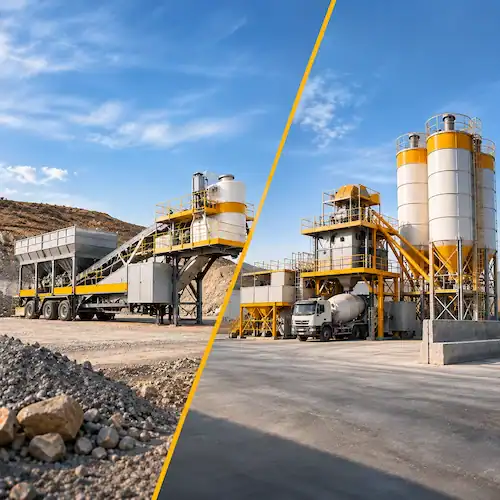
A mobile plant is designed for operations where the concrete production point may change between projects. A stationary plant is generally better suited to longer-term production from one permanent location, particularly where a larger supporting infrastructure is required.
CONMACH offers different concrete batching plant solutions for these operating models. Selection should therefore be based on how the plant will actually be used rather than on nominal capacity alone.
How Do Installation Requirements Differ?
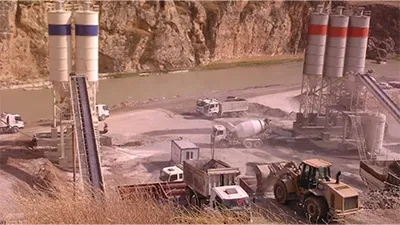
A stationary plant can be planned as part of a permanent production site. Foundations, aggregate storage, silo positions, vehicle circulation and maintenance areas can all be organised around long-term use.
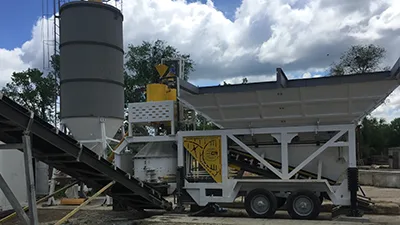
A mobile concrete batching plant is designed to make relocation and reinstallation easier. This does not mean that a mobile plant can operate without any site planning. Stable ground, utilities, aggregate supply and truck movement still need to be organised.
Why Does a Stationary Plant Require More Permanent Planning?
Long-term production makes it practical to develop supporting infrastructure around the plant.
The site may include:
- larger aggregate storage,
- multiple cement silos,
- permanent traffic routes,
- laboratory or quality-control areas,
- dedicated maintenance space,
- provision for future expansion.
This can increase initial site preparation, but it also allows the production environment to be optimised around continuous use.
Where Does Mobile Installation Provide an Advantage?
Mobility becomes valuable when the plant is expected to move after a road, bridge or construction project has been completed.
The investment can then continue operating at another location rather than remaining tied to the original site.
Relocation planning should still include the supporting equipment. Silos, aggregate handling systems and utilities also influence the total time and cost required to move the production operation.
How Do Mobile and Stationary Plants Differ in Capacity?
It is misleading to assume that every mobile plant is low-capacity and every stationary plant is high-capacity.
Modern mobile plants can achieve substantial concrete production rates. The more relevant difference is that stationary installations can often accommodate extensive storage and supporting equipment where long-term, continuous production is required.
Why Is Nominal Capacity Different From Actual Output?
Published capacity represents the production potential of the plant under defined operating conditions.
Actual output can be affected by:
- concrete recipe,
- mixer cycle time,
- aggregate weighing and feeding,
- cement and admixture dosing,
- truck availability,
- raw-material supply,
- shift and maintenance conditions.
A high-capacity mixer cannot maintain production if trucks or raw materials are repeatedly unavailable.
Plant selection should therefore consider daily logistics as well as peak hourly demand.
Why Does Material Storage Matter?
Continuous production requires continuous material supply.
If aggregate bins or cement storage repeatedly run empty, the mixer will spend part of the shift waiting rather than producing.
Stationary plants may offer more flexibility where large permanent storage systems are required. Mobile installations must balance adequate material supply with the need to preserve transportability and practical relocation.
How Do Operating and Maintenance Requirements Differ?
The choice between mobile and stationary equipment influences the way the entire operation is managed.
A stationary facility can be optimised around one location over many years. A mobile plant can allow the same investment to support different projects.
Neither arrangement eliminates routine maintenance.
How Does Project Duration Affect Selection?
A mobile plant can be particularly useful where one project is followed by another in a different location.
A stationary facility may be more appropriate when ready-mix concrete is produced continuously for the same market or when a large project requires production from one location for several years.
Useful questions include:
- How long will the plant remain at the first site?
- Is another project already planned?
- How stable is daily concrete demand?
- How much installation space is available?
- How many concrete recipes are required?
- How reliably can raw materials be delivered?
What Should Be Considered for Maintenance?
Mixers, conveyors, screw feeders, weighing systems, pneumatic components and automation all require inspection regardless of plant type.
A stationary plant can include permanent maintenance areas. For a mobile operation, service access and spare-parts logistics must remain practical at each new location.
Technical support and maintainability should therefore be evaluated together with capacity and initial investment.
Which Plant Type Is More Suitable?
A mobile plant is generally attractive when relocation is a real part of the operating model.
A stationary plant is often appropriate when production will remain in one location and the operation requires long-term storage, high utilisation and permanent supporting infrastructure.
The decision should not be made for one contract alone. The expected use of the plant over several projects can significantly change the economics of the investment.
Frequently Asked Questions
Can a mobile batching plant produce as much concrete as a stationary plant?
Some mobile configurations can provide high production capacity. Actual output depends on the entire production and logistics system.
Is a mobile plant always cheaper?
No. If mobility is not required, a stationary solution may provide a better long-term operating structure.
Can a stationary batching plant be relocated?
It can be dismantled and reinstalled, but it is not designed for frequent relocation in the same way as a mobile plant.
Which type is faster to install?
Mobile plants are generally developed with faster relocation and reinstallation in mind, although actual site requirements vary.
How should batching plant capacity be selected?
Peak demand, daily production, concrete recipes, storage and dispatch requirements should be considered together.
Choose the Plant Around Its Full Operating Life
The best plant is not simply the one with the highest capacity or shortest installation time. It is the one that matches the expected production pattern over the useful life of the investment.
Share your project duration, required output and relocation plans through the CONMACH contact page to evaluate an appropriate batching plant configuration.
Which Plant Type Is More Suitable?
A mobile plant is generally attractive when relocation is a real part of the operating model.
A stationary plant is often appropriate when production will remain in one location and the operation requires long-term storage, high utilisation and permanent supporting infrastructure.
The decision should not be made for one contract alone. The expected use of the plant over several projects can significantly change the economics of the investment.