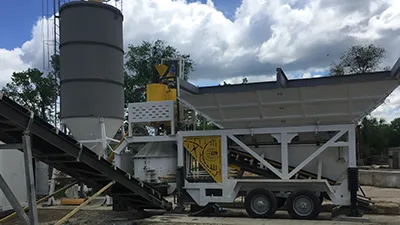
Mobile Concrete Batch Plant or Stationary Concrete Batch Plant? The scale, duration, and site conditions of the project are decisive factors in choosing a mobile concrete batch plant. Mobile concrete plants offer advantages in short-term projects spread across different locations or where the construction site is constantly changing, thanks to their portable structures. They are particularly preferred in road, dam, rural construction, and temporary construction sites due to their short setup and dismantling times, low infrastructure requirements, and quick commissioning capabilities. Working close to where the concrete is produced reduces transportation time, saving time and logistics costs. Their production capacities are generally lower than fixed plants and may be limited in projects requiring very high volumes of concrete.
Mobile Concrete Batch Plant or Stationary Concrete Batch Plant? Fixed concrete plants are a more suitable solution for long-term, high-volume, and continuous concrete production projects. Fixed plants offer high capacity and continuous production advantages in large-scale housing projects, infrastructure investments, and ready-mix concrete plants. Automation systems make it easier to standardize quality, and unit costs can decrease in the long term. However, they require a large area for installation, a strong infrastructure, and a higher initial investment. Therefore, fixed concrete plants are preferable for projects that will operate in a single location for a long time and plan to produce large amounts of concrete, while mobile concrete plants are a more suitable choice when flexibility, speed, and portability are required.
Differences Between Stationary and Mobile Concrete Batching Plants
The differences between stationary and mobile concrete plants are as follows:
- A stationary concrete plant is permanently installed in a single location, while a mobile concrete plant can be transported to different construction sites.
- Fixed plants are suitable for high-volume and continuous concrete production, while mobile plants are preferred for project-based production.
- The installation time for a stationary concrete plant is long, while a mobile concrete plant can be put into operation in a short time.
- Fixed plants require extensive land and infrastructure, while mobile plants can operate in confined spaces.
- Fixed concrete plants have higher automation and quality standards, while mobile plants prioritize practicality.
- Concrete is transported to the site in fixed plants, while production is carried out directly near the site in mobile plants.
- The initial investment cost for a stationary concrete plant is high, while a mobile concrete plant offers a lower initial cost.
- Fixed plants are suitable for long-term projects, while mobile plants are suitable for temporary and short-term jobs.
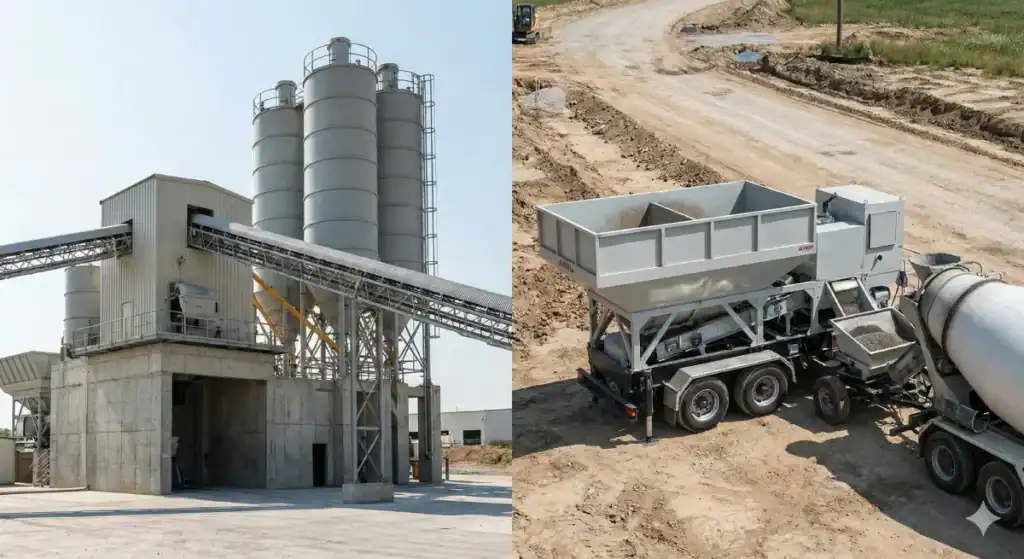
Advantages of Fixed Concrete Plants
Fixed concrete plants are preferred for projects requiring high-volume and long-term concrete production. In large-scale applications, infrastructure investments, and ready-mix concrete plants, the production continuity provided by fixed installations is a significant advantage.
Being installed in a single location facilitates standardization of the production process and enables more effective quality control. This makes it possible to achieve the same strength and mix ratios in every batch of concrete.
Advanced automation systems used in stationary plants make the production process more controlled and efficient. Operator errors are minimized, while recipe management and dosing are carried out with precision. This highlights the criteria of quality and continuity, especially when comparing concrete plants.
Another important advantage is that cost control is more predictable in the long term. Although the initial installation cost is higher compared to mobile solutions, the unit cost of concrete decreases thanks to continuous production. Energy consumption, maintenance planning, and labor utilization become more regular. Thanks to the fixed infrastructure, electricity, water, and automation lines can be permanently optimized.
Fixed plants are also advantageous in terms of environmental and operational order. Dust containment systems, noise control, and waste management can be planned more effectively. These features are particularly important for plants operating in urban or industrial areas. A fixed concrete plant is a powerful and sustainable choice for projects seeking high production capacity, quality standardization, and long-term cost advantages.
Mobile Concrete Plant Advantages
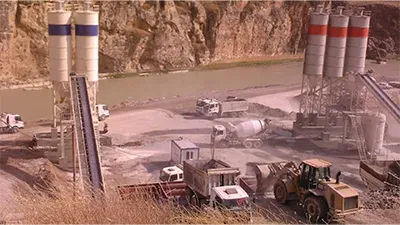
Preferred for projects requiring flexibility and speed, this production solution can be easily transported to different construction sites thanks to its portable structure and is ready for installation in a short time. This provides significant convenience for temporary projects, road construction works, dams, and construction projects carried out in remote locations. Having the concrete production point located close to the construction site reduces transportation time, improves time management, and contributes to more balanced cost planning.
One of the strongest aspects of mobile systems is their ability to adapt to the project duration. When the construction site is completed, the plant can be dismantled and put back into operation in another area. This makes it possible to continue concrete production without requiring investment in fixed infrastructure. Thanks to its reduced space requirements, it can operate effectively even in confined construction site conditions. Short installation and dismantling times contribute to the progress of projects without delays.
Logistical planning becomes simpler because the aggregate and other raw materials used in the production process can be sourced close to the site. In projects carried out in remote areas, this structure makes the planning and implementation process more manageable.